
I am bringing back the Quarterly Book List, albeit at the fag end of this year. But late is better than never….
I also wanted to end the year with advancing awareness around Feminism- a much maligned & misunderstood movement.
At its core, feminism began as a movement to give voice
to women’s experiences and to end women’s subordination fuelled by the invisibilazation of women from the political, philosophical and societal spheres against the backdrop of a working class movement in USA.
Women have been at the forefront of driving this movement, with feminist men extending their support wherever needed, at first it started with advocating for equal voting rights for women post the successful Black Suffrage movement.
In India, equal voting rights came enshrined in the Constitution thanks to the Constituent Assembly of India which incorporated universal suffrage in the ratified Constitution.
Like a glacial stream branching into tributaries, the movement gathered steam around 1960s-70s and attracted more marginalized groups. Today’s feminism, or what’s often called the third wave, is largely intersectional, striving to be inclusive of other socio-cultural minorities.
I’ve been wondering about which feminist books and authors to platform, considering there are so many celebrated, impassive books around the Feminist Movement around the globe. The solidarity sisterhood, that historically didn’t really centre the working class women, women of color and women of global south.
But did India have a homegrown Feminist movement? We did! In the first half of the 20th century when feminists like Kamini Roy led the first women’s suffrage campaign , Savitri Bai Phule and Jyotiba Phule opened the first schools for girls from all castes against the diktat of the Brahmins. With India’s very own Second Sex, Stree Purush Tulana written by Tarabai Shinde,; and Pandita Ramabai, who criticized patriarchy and caste-system in Hinduism, married outside her caste and converted to Christianity (1880s). Raja RamMohun Roy who played a key role in the abolishment of sati pratha and widow remarriage.
There was one interesting dichotomy here: British reformers encouraged the reforms unlike back home. Was it because these reforms were direct attacks on the prevalent faith of the people they were ruling and a subordination tactic? The reforms were also inconsistently applied and also came with political interests.
But whatever be the reason, we must give credit where it’s due.
Anyhow, to begin the process of shortlisting the books I would want to read, I set a few conditions, primarily based on what appeals to me- intersectional feminism, global south focused given our unique socio-cultural make-up and the challenges emanating from it.
I’ve shortlisted four books ( three of which I’ve already acquired and the first one, already read), so these are in a way, self-affirming, but if the rationale behind this selection appeals to you, then you would find these picks unputdownable….
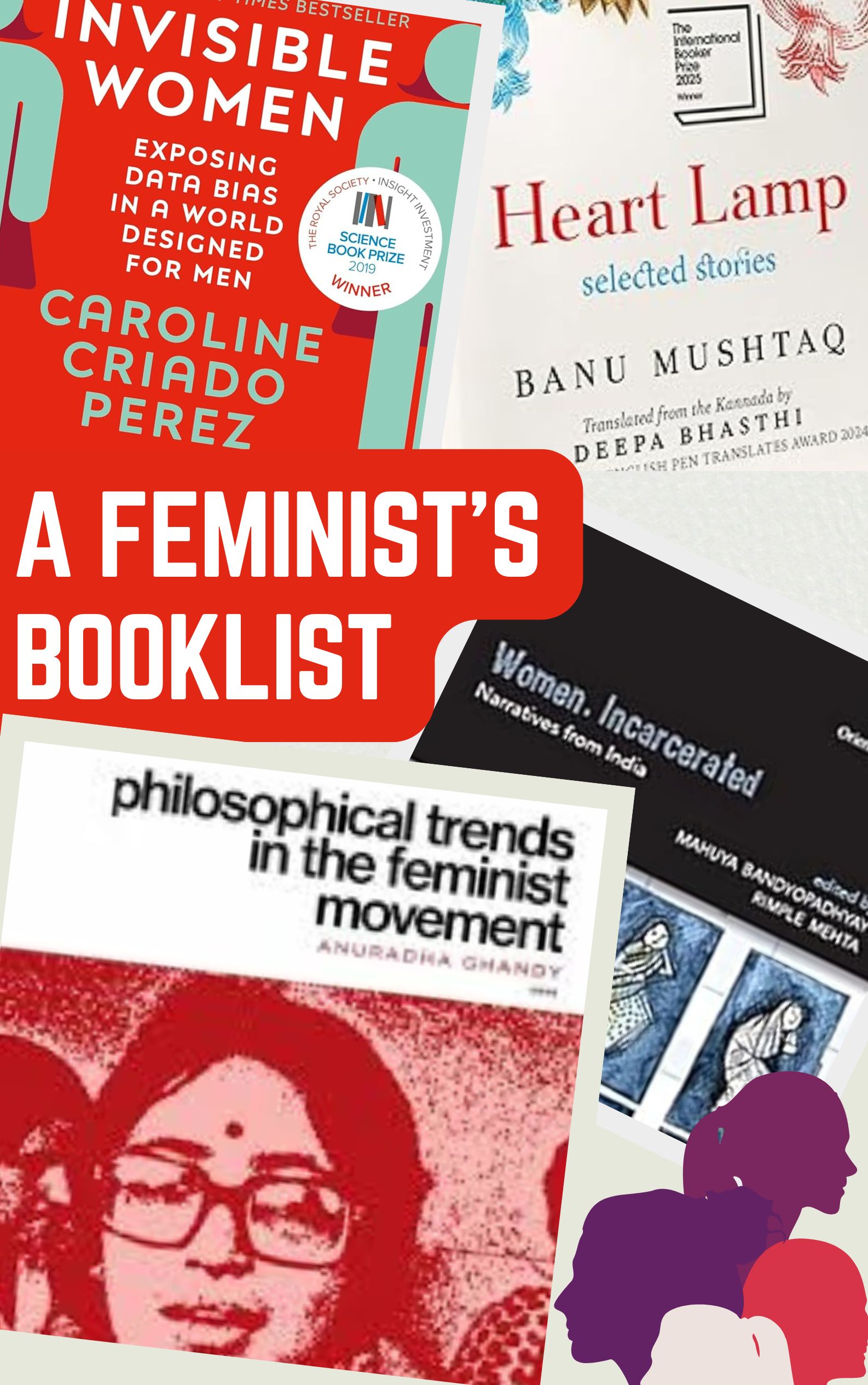
Invisible Women- Exposing Data Bias: Every generation of feminist scholars rediscovers Simone de Beauvoir‘s 1949 observations that women are the second sex. You’ve probably experienced the repercussions of the gender data gap in your everyday life. from your annual health check-ups to the words you speak. The book traces the history of this gap, right from the days of the Hunter and the Gatherer and provides evidence that women continue to be the second sex, the other, while men are the default, even as Artificial Intelligence looms over humanity.
Philosophical trends in the Feminist Movement– By Anuradha Ghandy
This has been the most fascinating as much for its author as for its content. Anuradha Ghandy(née Shanbag)was a Marxist-Communist revolutionary, deemed an enemy of the Indian State. She succumbed to a rare form of Malaria, worsened by delayed medical intervention due to her anonymity at the doctor’s office.
Despite coming from a privileged Communist family, she chose to live among Dalit bastis in Nagpur. She helped lead one of India’s largest feminist collectives (now banned).
She played a key role in one of India’s largest feminist groups( now banned). It is difficult to reconcile the image of a frail, bespectacled woman with that of a Naxalite insurgent, yet her theoretical contributions to feminist thought are seminal.
This book, published posthumously, a comprehensive guide on Feminism’s many forms, enriched by her own notes, and a foreword by Arundhati Roy who also worked on compiling it.
As her husband noted in his heartwarming post on her second death anniversary, she had the rare ability to combine activism with theoretical insight.
Women, Incarcerated: Narratives from India– by Mahuya Bandyopadhyay& Rimple Mehta: The book narrates the experiences of exclusion, marginalization, and violence in the lives of women prisoners in India. Researchers visited prisons across Maharashtra, Punjab, West Bengal & Uttar Pradesh to understand the carceral lives of women prisoners, the impact of patriarchal practices in prison administration and how the gendered attitude of society towards women extend into their lives within confinement.
This is an important work because prisons are the most overlooked spaces when we discuss societal issues, it’s considered, and also functions as an almost inert space which is perhaps considered immune from normative practices. But the book presents a striking account of the reaches of patriarchy in the daily lives of prisoners ranging from gendered roles to prison management’s behavior towards men and women.
Heart Lamp; Banu Mushtaq, translated into English by Deepa Bhasthi: Written originally in Kannada, it became the first translated short story collection to win the International Booker prize this year. Through twelve short stories it chronicles the lives of girl and women in Muslim communities overwhelmed under the weight of religion, society, and politics. Hailed as deceptively simple, yet painfully profound, the stories are acclaimed for their vivid imagery and stark socio-cultural and political commentary.
I leave it to you to pick one, two or all of these, Anuradha Ghandi’s book is freely available on the linked site while others are available in major bookstores and/ or e-commerce sites.
With increased polarization around the world, these books provide a well-rounded perspective around women’s issues past and present, as a reminder that the lessons from yesterday are indispensable for defending human rights today and tomorrow.
 Fingers in symphony